
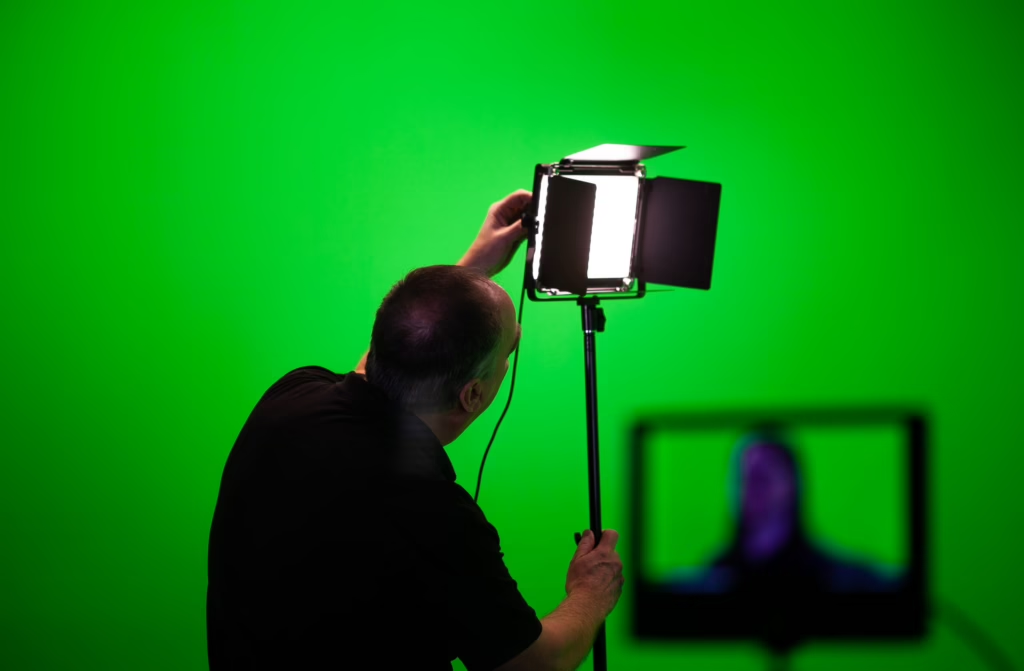
A presenter can deliver the perfect line, but poor lighting can still leave the shot looking flat, distracting, or completely different from what the production intended. TV studio lighting helps control how people, sets, colors, and details appear on camera while also shaping the mood of the finished scene. From key and fill lights to LEDs, practical lighting, and three-point setups, there are several types of lighting used in television production, each with a different purpose. If you want to work in television, film, broadcasting, or digital video, understanding these techniques can help you see how lighting works with the camera to turn a set into a finished shot.
Below, we break down the main television lighting techniques, explain how they work, and show why lighting knowledge matters for anyone interested in media production.
What You Should Know Before You Start
What’s the most common mistake made with different types of lighting in television production?
- Overlighting the subject until the shadows that give a face its shape disappear entirely.
- Lighting the talent well while leaving the background at a completely different light level, which breaks the illusion of one continuous scene.
- Skipping a light meter check, which leaves exposure inconsistent from one camera angle to the next.
Do you need to own lighting equipment to learn this skill?
- No, most broadcasting and production programs give you access to a fully equipped studio and its lighting fixtures.
- A single light and a reflector teach you more about lighting ratio and placement than an expensive kit does on its own.
- Understanding where to put a light matters more early on than owning premium gear.
What’s the one lighting decision that shapes everything else on a shoot?
- Where you place the key light, since every other light source on set responds to it.
- A poorly placed key light creates problems that fill light and backlight cannot fully fix afterward.
- Get the key light right first, then build the rest of the lighting plan around it.
Table of Contents
- What Is TV Studio Lighting?
- What Are the Main Types of Lighting in Television Production?
- How Does a Three-Point Lighting Setup Work?
- High-Key Lighting vs. Low-Key Lighting
- Practical Lights, Motivated Lighting, and Color Temperature
- Why LED Lights Are Common in Modern TV Lighting
- How Do You Build a Lighting Plan for TV Production?
- Is Studio Lighting a Good Investment for Your Media Career?
- Learn TV Studio Lighting by Doing It
- Frequently Asked Questions
What Is TV Studio Lighting?
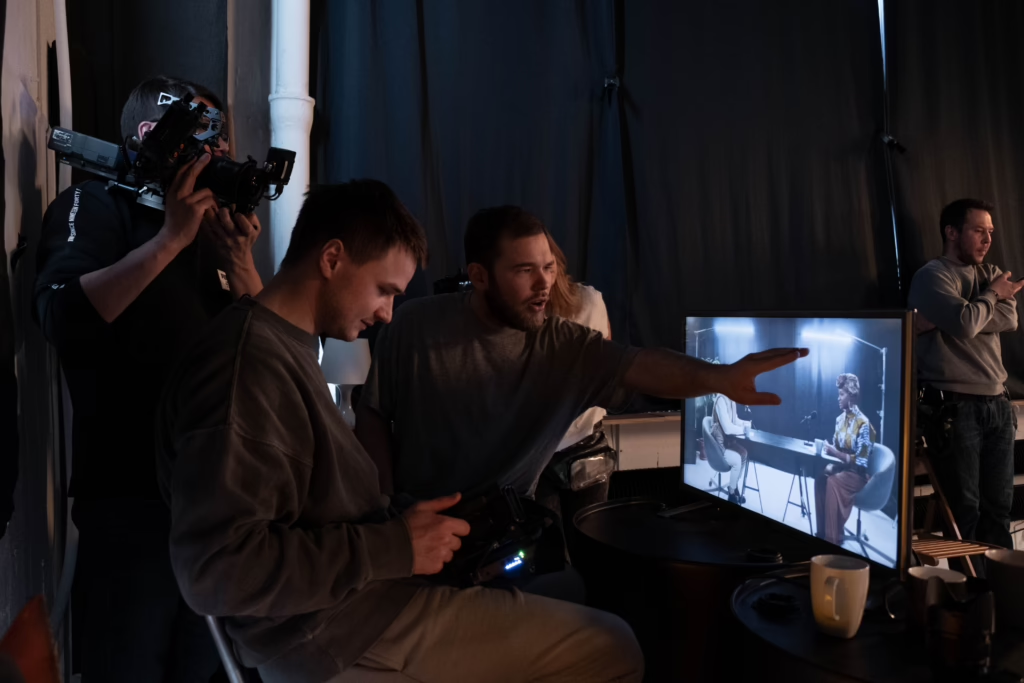
TV studio lighting is the planned use of natural and artificial light to control how people, sets, and objects appear on camera. A good lighting plan manages exposure, color temperature, highlights, shadows, contrast, and visual interest rather than simply adding more light.
Who controls that lighting can depend on the production:
- A lighting designer or lighting director may shape the overall lighting approach, while a gaffer leads the electrical lighting crew on many film and television sets.
- The best boy electric supports the gaffer with crew, equipment, and logistics.
- Whatever the crew structure, every lighting instrument should have a clear purpose within the overall setup.
This is why lighting is important in TV production. Our eyes can adapt quickly as light levels and color change, but a camera responds differently. Lighting that looks acceptable when you are standing on set can appear muddy, harsh, overly bright, or strangely colored once viewed through a camera lens.
That is why professional lighting decisions are ultimately judged through the camera and monitor, not simply by looking at the set.
What Are the Main Types of Lighting in Television Production?
Television lighting can be described by the role a light plays, its source, and the quality of light it produces.
Some of the most common lights and lighting techniques include:
- Key light: The primary light source that gives the subject shape and establishes the main direction of the lighting.
- Fill light: A softer source, often placed opposite the key, that reduces or controls shadows.
- Backlight, hair light, or rim light: Light positioned behind or around the subject to create separation from the background and add depth.
- Practical lights: Visible light sources within the shot, such as lamps, screens, signs, or other fixtures.
- Natural and ambient light: Existing illumination from daylight or the surrounding environment.
- Hard light: More directional light that produces clearly defined shadows.
- Soft light: Broader or diffused light that creates gentler transitions between highlights and shadows.
- Side lighting: Light coming primarily from one side of the subject, often used to reveal shape, texture, or create a more dramatic image.
These different uses of lighting in TV production give a lighting team control over much more than brightness. Lighting can direct the viewer’s attention, separate subjects from their surroundings, reveal texture, flatter a presenter, or change the emotional tone of an entire scene.
How Does a Three-Point Lighting Setup Work?
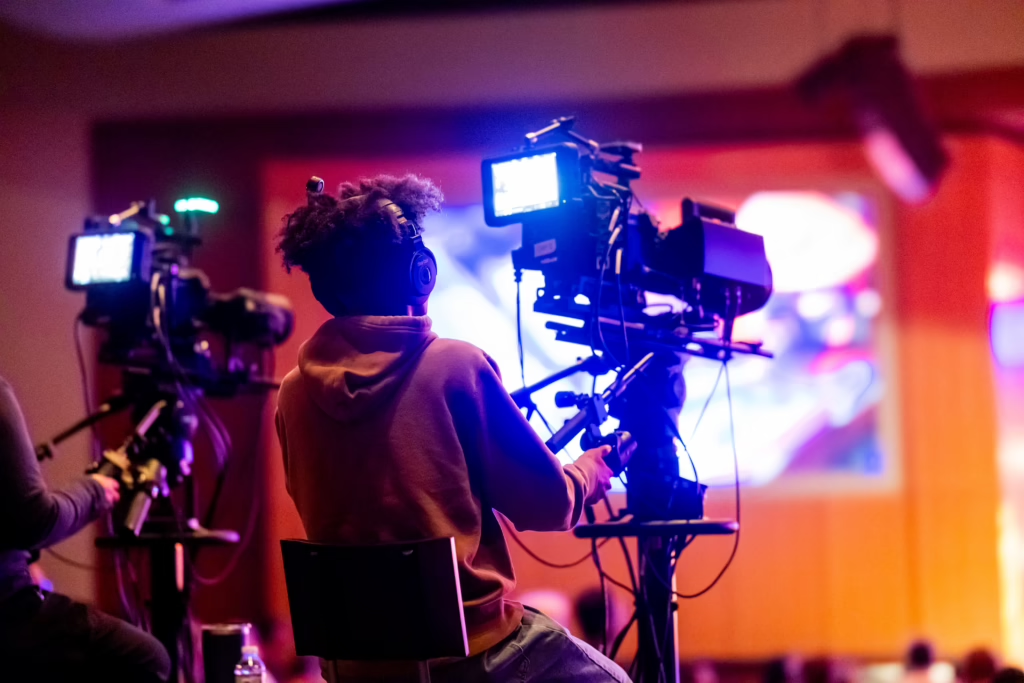
Three-point lighting is one of the best-known television and film lighting techniques because it demonstrates how different light sources can work together.
A traditional three-point lighting setup uses:
- Key light: The main source of light on the subject.
- Fill light: A softer source that controls the shadows produced by the key.
- Backlight or rim light: A source positioned behind the subject to help create separation from the background.
The relationship between the key and fill lights controls the lighting ratio and therefore the amount of contrast in the image. More fill generally creates a brighter, more even look, while less fill allows stronger shadows and greater contrast.
There is no single lighting ratio that works for every production. The right balance depends on factors such as the camera, skin tones, set, format, and creative goal.
Three-point lighting is also a foundation rather than a strict rule. Once you understand what the key, fill, and backlight are doing, you can adapt the setup for interviews, live events, film shoots, still photography, and television productions where space or equipment is limited.
High-Key Lighting vs. Low-Key Lighting
High-key lighting and low-key lighting use contrast in very different ways.
What Is High-Key Lighting?
- High-key lighting keeps light levels relatively even and normally uses more fill to reduce deep shadows. The result is a brighter, lower-contrast image.
- This approach works well for formats such as news, talk shows, sitcoms, and other productions where clarity, energy, and openness are important.
- High-key lighting is associated with bright, lower-contrast scenes.
What Is Low-Key Lighting?
- Low-key lighting uses less fill and makes shadows a more noticeable part of the image. This creates stronger contrast and can establish a darker or more dramatic emotional tone.
- It is commonly used in drama, interviews, night scenes, thrillers, and horror films.
- Low-key lighting is commonly associated with darker, higher-contrast imagery.
- Understanding both styles matters because television lighting is both creative and technical.
- A brightly lit morning show and a tense dramatic interview could be filmed in the same physical space but feel completely different because of the lighting choices.
Practical Lights, Motivated Lighting, and Color Temperature
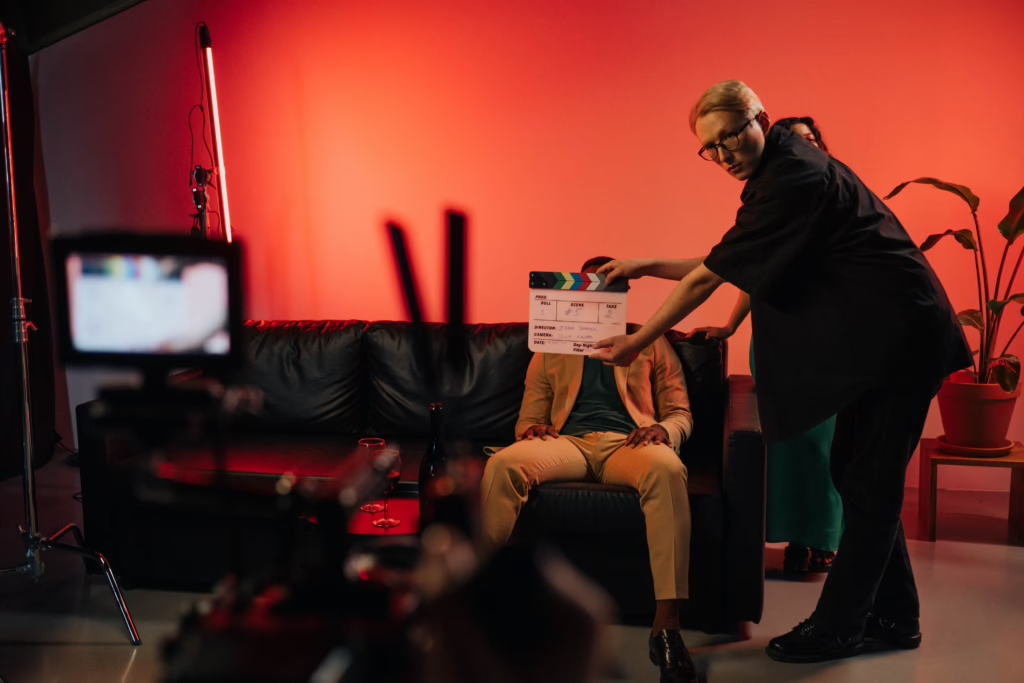
Some of the most convincing television lighting does not look like studio lighting at all.
Practical lights are sources that viewers can actually see in the shot, such as a lamp, a neon sign, a computer screen, or an overhead fixture.
Motivated lighting uses off-camera lights to imitate or strengthen a believable source within the scene. For example, a crew might use an artificial light outside a window to create the impression of daylight entering the room.
This can work especially well in a night scene, where visible lamps or other practical lights give the viewer a logical reason for the light falling across a person’s face while hidden fixtures provide the illumination the camera actually needs.
Why Color Temperature Matters
Color temperature affects how warm or cool a light appears.
Two common production reference points are:
- Daylight: approximately 5,600 K
- Tungsten: approximately 3,200 K
Real-world light sources vary, so these numbers are starting points rather than universal rules.
Mixing daylight, tungsten fixtures, LEDs, and practical lights can result in unwanted color shifts if the setup is not controlled.
White balance, colored gels, diffusion, and adjustable LED instruments can all help crews manage color consistency and natural-looking skin tones.
A good lighting plan does not necessarily require every source to have exactly the same color temperature. It requires those differences to be intentional.
Why LED Lights Are Common in Modern TV Lighting
LED lights have become common in modern TV lighting because they offer flexible control while generally producing less heat and requiring less power than many traditional tungsten fixtures.
Professional LED lighting instruments can offer adjustable brightness and color temperature, and high-quality fixtures can provide the color accuracy needed for cameras and natural-looking skin tones.
That flexibility is especially useful in television production and live events, where crews may need to change the look of a set quickly between segments. Efficient fixtures can also reduce electrical demands when power is limited.
Professional broadcast LEDs may also be evaluated using metrics such as CRI and TLCI to assess how accurately colors are reproduced on camera.
The fixture itself is only part of the setup. Crews also use lighting-control tools such as:
- Barn doors to limit spill
- Diffusion to create broader, softer light
- Flags to block unwanted light
- Colored gels to change color
- Fresnel fixtures to control the beam between spot and flood
Color performance varies across fixtures, so a mid-range LED is not automatically suitable for every broadcast environment. Crews should consider color accuracy, flicker, output, and consistency with the camera system in use.
Our guide to broadcasting equipment covers more of the tools you may encounter in a professional studio.
How Do You Build a Lighting Plan for TV Production?
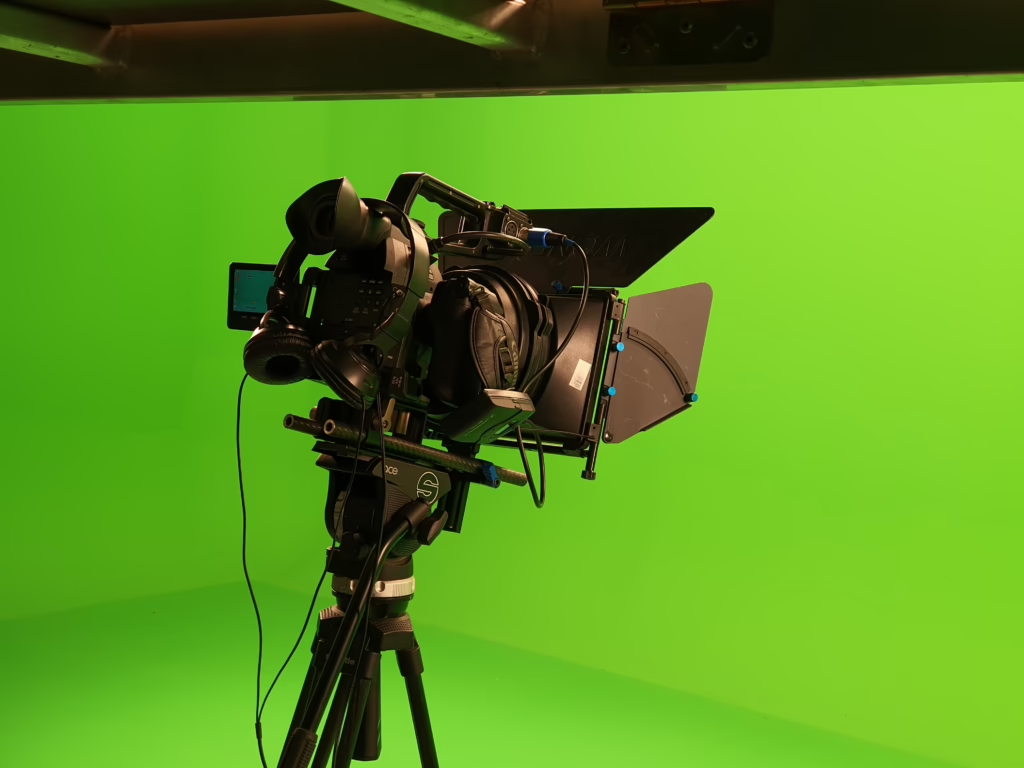
A good lighting plan starts with the shot you need to create, not with how much equipment you have.
- Read the environment: Look at natural light, ambient lighting, practical lights, windows, and existing fixtures.
- Choose the key light: Decide where the main source should come from and whether the scene calls for hard or soft light.
- Control the contrast: Add or adjust a fill light if shadows from the key are too deep.
- Create separation: Use a hair light, backlight, or rim light when needed to help separate the subject from the background.
- Check color: Compare the color temperatures of LEDs, tungsten fixtures, daylight, and other sources.
- Shape the light: Use barn doors, diffusion, gels, or flags to soften the beam, block spill, or control shadows.
- Check the camera: Confirm exposure, highlight detail, shadows, color, and skin tones using the camera and production monitor.
The same basic process can be adapted across film, television, interviews, digital media, and many other lighting setups.
It also demonstrates one of the most important principles of lighting: more light is not always better. Good lighting design is about placing the right light in the right place to create the image you want.
Is Studio Lighting a Good Investment for Your Media Career?
If you want to work in media but do not plan to become a professional lighting designer, learning studio lighting can still be extremely useful.
Producers, directors, camera operators, broadcasters, editors, and content creators all benefit from understanding how light affects an image.
Knowing the basics of TV studio lighting can help you:
- Recognize when a shot needs more or less light
- Communicate more clearly with camera and lighting crews
- Understand why a key, fill, or rim light needs to move
- Respond when natural light changes during a shoot
- Work more effectively when equipment is limited
- Understand lighting-related problems that may affect post-production
You also do not need an expensive studio lighting kit to begin learning. A single light source, a reflector, and a camera can teach you a great deal about direction, contrast, hard and soft light, and shadows.
Equipment will continue to change, but the principles behind good television and film lighting remain useful across formats.
Learn TV Studio Lighting by Doing It
Reading about lighting techniques can give you the foundation. But moving a key light, adjusting a fill, seeing the resulting shadows on a production monitor, and experimenting with different setups is where the theory starts to become practical.
Our BeOnAir Film & Video Production program includes camera and lighting training as part of a broader curriculum that covers pre-production, production, and post-production.
If you want broader content-production experience, our Digital Media Production program develops skills across audio, video, storytelling, digital content, and multiplatform production.
Our Radio & TV Broadcasting program also gives you hands-on exposure to television production, cameras, studio environments, and the technical side of broadcasting.
You can learn more about BeOnAir and see how hands-on training connects creative decisions with real production workflows.
Ready to Get Behind the Lights?
The best way to understand TV studio lighting is to work with it.
If you want hands-on experience with lighting setups, cameras, and television production, explore BeOnAir’s Film & Video Production program or book a campus tour to see the production environment for yourself.
Ready to start developing practical media skills? Apply online or contact our admissions team to find the BeOnAir program that fits your goals.
Frequently Asked Questions
Why is lighting important in TV production if modern cameras work in low light?
Being able to record an image in low light does not replace a good lighting plan. TV lighting controls exposure, shape, color temperature, skin tones, contrast, visual interest, and the relationship between a subject and the background. A camera may capture the scene, but the lighting determines how that scene looks and feels to the audience.
What is the most important light in a three-point lighting setup?
The key light is normally the main light in a three-point lighting setup because it establishes the dominant direction and shape of the lighting. The fill light controls the shadows created by the key, while the backlight or rim light helps separate the subject from the background. All three work together to create the final image.
What is the difference between hard light and soft light?
Hard light typically comes from a smaller or less-diffused source and produces more clearly defined shadows. Soft light comes from a larger or more diffused source and creates gentler transitions between light and shadow. Both have different uses in TV production. Soft light is often useful for interviews and presenters, while harder or more directional light can reveal texture or create a more dramatic image.
Do diffusion gels and colored gels do the same thing?
No. Diffusion is used to soften or spread light, while colored gels alter its color. Both can be part of a lighting setup, but they solve different problems. Crews may use them when working with LEDs, tungsten fixtures, daylight, practical lights, and other sources.
Can TV studio lighting skills be used outside television?
Yes. The same core lighting principles are used in film production, digital media, live events, still photography, streaming, and online video. Understanding light direction, contrast, color temperature, exposure, and three-point lighting gives you skills that can transfer across many areas of media production.