
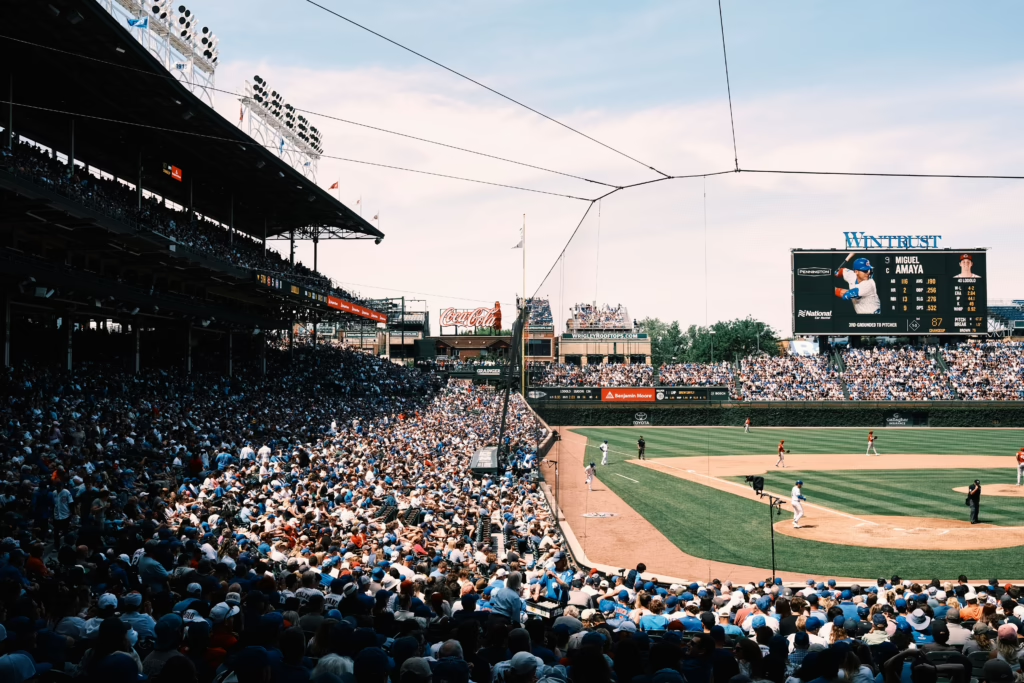
You can know the score of a baseball game without hearing a single word from the booth. A great announcer gives you something more. They can make you feel the tension before the pitch, the roar after a home run, the personality of the players, and the feeling that you are sitting inside Wrigley Field even when you are miles away. That is what generations of Chicago Cubs announcers have done. From Jack Brickhouse and Harry Caray to Pat Hughes and today’s broadcast teams, the history of Cubs broadcasting shows aspiring sportscasters how to find their voice, call live action, work with an analyst, and build a lasting connection with fans.
If you want to turn your love of sports into a broadcasting career, those lessons are worth studying. Through our Sports Broadcasting program, you can then start practicing them yourself.
What You Should Know Before You Start
What does it take to land your first play-by-play job?
- Most broadcasters start by calling small college, high school, or amateur games first.
- A demo reel of your own calls carries more weight than a diploma alone.
- That reel starts with live reps behind a microphone, not more TV watching.
Do you need connections in a market like Chicago to get noticed?
- Broadcasters usually build a reputation through consistent, recorded work, not networking events.
- Stations evaluate pacing, accuracy, and personality on tape before asking who referred you.
- Repetition matters more than who you know when you are starting out.
What is the most common mistake new broadcasters make in the booth?
- New announcers often talk too much and crowd the natural rhythm of a game.
- Knowing when to stay quiet takes as much skill as knowing what to say.
- That instinct only develops by calling live games repeatedly, with honest feedback.
Table of Contents
- Who Are the Chicago Cubs Announcers Today?
- What Can Future Broadcasters Learn From Chicago Cubs Announcers?
- Lesson 1: Build a Voice People Recognize
- Lesson 2: Know What to Say and What to Leave Out
- Lesson 3: Preparation Gives You Something Worth Saying
- Lesson 4: Broadcasting Is a Conversation
- Lesson 5: Know the Game and Your Audience
- Lesson 6: Your Broadcasting Career Has to Adapt
- What Does Cubs Broadcasting History Teach You About Starting Out?
- Start Practicing Your Own Play-by-Play
- Frequently Asked Questions
Who Are the Chicago Cubs Announcers Today?
As of 2026, Jon “Boog” Sciambi handles Chicago Cubs television play-by-play alongside analyst Jim Deshaies. On radio, Pat Hughes calls the action with analyst Ron Coomer, with games airing on 670 AM The Score and the Cubs Radio Network.
Today’s broadcasters continue a tradition that includes some of the most recognizable voices in baseball, but each generation has approached the booth differently. That is what makes Cubs broadcasting history so useful for future sportscasters to study.
What Can Future Broadcasters Learn From Chicago Cubs Announcers?
The technology surrounding the Chicago Cubs has changed enormously. Early fans listened on local radio stations. WGN later brought Cubs baseball and Wrigley Field to television viewers across the country. Today, fans can follow games through radio, TV, streaming, and digital platforms.
The fundamentals of the job have changed much less.
A sportscaster still needs to:
- Describe live action accurately without talking over every moment.
- Turn statistics and preparation into a story people want to hear.
- Develop a recognizable voice without forcing a personality.
- Work naturally with a broadcast partner.
- Understand the game well enough to explain what happens next.
- Stay composed when a game suddenly changes.
- Connect with longtime fans and people watching for the first time.
The best Cubs announcers each demonstrate a different part of that skill set.
Lesson 1: Build a Voice People Recognize
Long before every game was available on multiple screens, an announcer’s voice was often the connection between a team and its fans.
Jack Brickhouse became one of the defining Cubs voices of the 20th century. His excited “Hey Hey!” home run call was simple, memorable, and unmistakably his. Brickhouse received the Ford C. Frick Award for broadcasting excellence in 1983. (Baseball Hall of Fame)
Then came Harry Caray.
Born Harry Christopher Carabina, Caray developed his career across several teams before joining the Cubs in 1982. His “Holy Cow” expression dated back to his earlier broadcasting years, but at Wrigley Field it became part of one of baseball’s most recognizable broadcasting personalities. (SABR)
Caray sang during the seventh-inning stretch, joked with fans, reacted honestly to the game, and made broadcasts feel more like conversations than performances.
The lesson for a future announcer is not to copy “Holy Cow.” It is to discover what makes you sound like you.
Your early calls may sound like broadcasters you admire. Over time, the goal is to develop a style listeners recognize as your own.
Lesson 2: Great Play-by-Play Is About Knowing What to Say and What to Leave Out
One of the easiest mistakes to make when you first try play-by-play is describing everything.
Great broadcasters learn that silence has a job too.
Vince Lloyd demonstrated how effective clear, economical description could be. After Cubs announcer Jack Quinlan died in a spring training automobile accident in 1965, Lloyd moved into the radio booth alongside Lou Boudreau. His calls were direct and descriptive, while “Holy Mackerel” became his own recognizable expression. (SABR)
His wider career across several sports also highlights an important lesson: play-by-play is a transferable skill.
You need to know:
- What the audience cannot see.
- Which detail matters right now.
- When a statistic adds something.
- How quickly to react.
- When crowd noise can tell the story better than you can.
You will not master that after calling a handful of games. Strong play-by-play comes from repetition, listening back to your work, and learning how to keep pace with live action without rushing it.
Lesson 3: Preparation Gives You Something Worth Saying
Personality may attract listeners. Knowledge keeps the broadcast useful.
That is where former players such as Steve Stone, Ron Santo, Bob Brenly, and Jim Deshaies brought something different to Cubs broadcasts.
Steve Stone had already spent years as a Major League Baseball pitcher and won the 1980 American League Cy Young Award before becoming a broadcaster. Alongside Harry Caray, his knowledge of pitching and strategy helped viewers understand not just what happened, but why. Stone later credited Caray with teaching him how important it was to entertain as well as inform. (SABR)
Former Cubs player Ron Santo brought another style. He joined Cubs radio in 1990 and later entered the Baseball Hall of Fame in 2012. (Baseball Hall of Fame)
Santo did not hide how much he cared about the team. His reactions and long partnership with Pat Hughes made him feel connected to the Cubs fans listening alongside him.
Later analysts including Bob Brenly and Jim Deshaies brought their own playing and baseball experience into the booth.
The lesson is not that every analyst needs to be a former professional player. It is that you need to prepare enough to add something the audience does not already know.
That insight can come from playing experience, research, statistics, interviews, or studying the game.
Lesson 4: Broadcasting Is a Conversation, Not Two People Taking Turns
Listen to a strong sports broadcast and pay attention to what happens between plays.
The best partners respond to each other. They know when to challenge a point, add context, make a joke, or hand the moment back to the game.
Harry Caray and Steve Stone worked because their personalities contrasted. Pat Hughes and Ron Santo worked because Hughes could keep the broadcast moving while Santo reacted like one of the fans listening at home.
Pat Hughes also demonstrates the value of consistency. Before joining Cubs radio in 1996, he called minor-league baseball and worked with the Minnesota Twins and Milwaukee Brewers.
He went on to call the final out of the Cubs’ 2016 World Series championship, ending the team’s 108-year championship wait, and received the Ford C. Frick Award in 2023.
That career path matters for future broadcasters because a major-league booth is rarely where the journey begins.
Your first opportunity may involve a smaller station, school sports, local games, or a league far from the one you ultimately hope to call. What matters is getting live repetitions and building work you can show someone.
Lesson 5: Know the Game, but Remember Who You Are Talking To
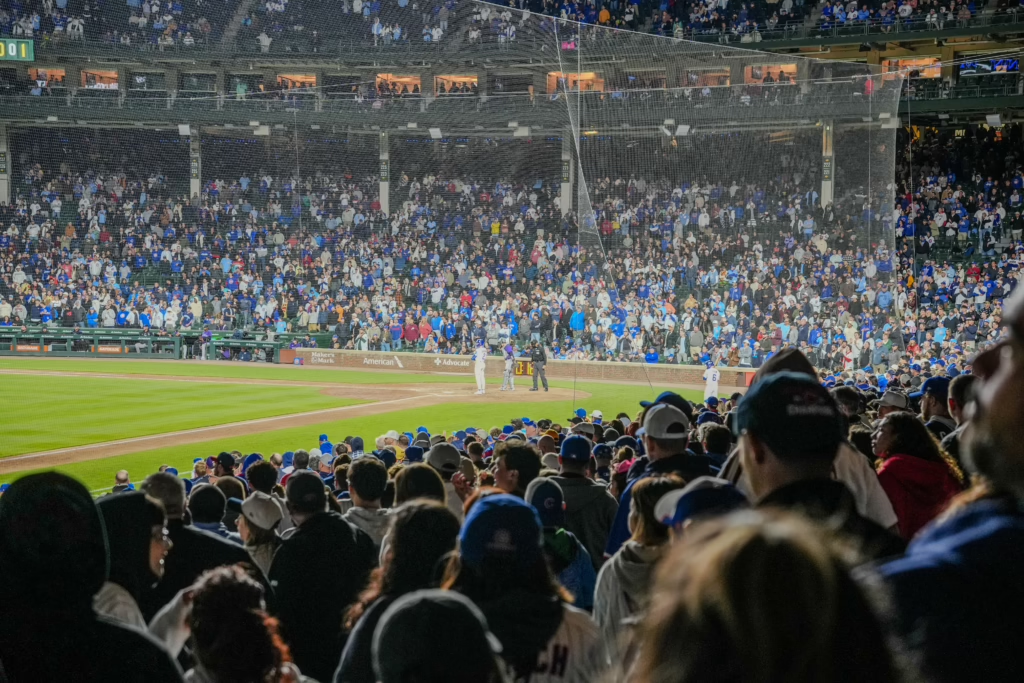
Cubs broadcasting has always had a strong relationship with its audience.
Caray understood that especially well. He interacted with people in the bleachers, made the seventh-inning stretch part of the experience, and filled slower innings with stories, humor, and conversation. (SABR)
You cannot predict when a pitcher will throw a no-hitter or when a Cubs player will hit a dramatic home run. You can prepare for the spaces between those moments.
Know the players. Know the league. Understand the season. Research the opposing team. Have useful information ready, but do not force every statistic into the broadcast simply because you prepared it.
The audience should never feel as though you are reading your notes at them.
The best broadcasters turn research into conversation.
Lesson 6: Your Broadcasting Career Has to Adapt
The Cubs booth has changed alongside the media industry.
WGN television helped introduce Cubs baseball to audiences well beyond Chicago. Radio remained important, and new networks, streaming services, and digital platforms followed.
The announcers adapted too.
Len Kasper spent 16 seasons as a Cubs television play-by-play voice before moving to the Chicago White Sox radio booth in 2021. His career demonstrates that your broadcasting career does not have to belong to one format, network, or team.
Beth Mowins made another kind of history. In 2021, she became the first woman to handle play-by-play for a Cubs regular-season game. In 2024, she joined Elise Menaker and Taylor McGregor for the first all-female Cubs broadcast crew.
Today’s television team of Jon “Boog” Sciambi and Jim Deshaies and radio pairing of Pat Hughes and Ron Coomer reflect that multiplatform era.
Different voices. Different platforms. The same basic requirement: make the game clearer and more interesting for the person listening or watching.
What Does Cubs Broadcasting History Teach You About Starting Out?
It is easy to look at a famous booth at Wrigley Field and see only the finished career.
Look further back and the story changes.
Harry Caray worked at smaller radio stations before becoming one of baseball’s best-known voices. Pat Hughes called minor-league games. Steve Stone had to learn an entirely new profession after life as a pitcher. Other Cubs announcers moved between teams, markets, radio, and television.
Their careers were not built around one perfect audition. They were built by calling games.
There is also no single formula for the “right” way to sound. Jack Brickhouse did not sound like Harry Caray. Caray did not sound like Pat Hughes. Ron Santo did not approach the booth like Steve Stone.
They learned the fundamentals and then brought themselves to the broadcast.
Start Practicing Your Own Play-by-Play
You can study Chicago Cubs announcers for hours, but eventually listening has to become doing.
Pick a game. Turn down the broadcast. Put on a headset and call the action yourself.
Then listen back.
Were you accurate? Did you leave enough space for the game to breathe? Did your voice change naturally when something happened? Could someone understand the play without seeing it? Did you fill quieter moments with useful information, or simply talk because the microphone was on?
That is the kind of practice behind sports broadcasting.
Through BeOnAir’s Sports Broadcasting program, students can work on play-by-play, sports reporting, studio production, interviewing, editing, and other skills involved in creating a broadcast.
If Cubs history is what drew you toward the industry, our Illinois Media School campus in Chicago puts your training in the same city where generations of those voices built their careers.
Across our seven campuses, the goal is not to teach you to become the next Harry Caray. It is to help you start developing your own voice.
Could Your Voice Be the One Fans Remember?
Jack Brickhouse, Harry Caray, Ron Santo, Steve Stone, Pat Hughes, and the other great Cubs voices did not begin in the Wrigley Field booth. They developed their skills one game, one season, and one opportunity at a time.
If you want to start doing the same, apply to BeOnAir or contact our admissions team to find the program that fits your goals.
Frequently Asked Questions
Who is the most famous Chicago Cubs announcer?
Harry Caray is one of the most famous voices associated with the Cubs, thanks to “Holy Cow,” his energetic calls, and his tradition of leading fans during the seventh-inning stretch at Wrigley Field.
Jack Brickhouse and Pat Hughes are also major figures in Cubs broadcasting history, and all three received the Ford C. Frick Award for broadcasting excellence. (Baseball Hall of Fame)
Who are the Chicago Cubs TV and radio announcers in 2026?
Jon “Boog” Sciambi handles television play-by-play with analyst Jim Deshaies. On radio, Pat Hughes handles play-by-play alongside Ron Coomer. Cubs radio games air on 670 AM The Score and through the team’s radio network.
Do you need to play Major League Baseball, like Ron Santo, Steve Stone, Ron Coomer and Jim Deshaies, to become a sports announcer?
No. Former players such as Ron Santo, Steve Stone, Ron Coomer, Jim Deshaies, and Bob Brenly brought playing experience to the booth, but play-by-play announcers such as Pat Hughes built their careers through broadcasting. Knowledge of baseball matters, but so do preparation, communication, timing, storytelling, and the ability to describe live sports clearly.
Why was Harry Caray so popular with Cubs fans?
Caray made the audience feel part of the game. His excitement, “Holy Cow” reaction, conversations with Steve Stone, and seventh-inning stretch created a style closely connected to the people inside Wrigley Field. For future broadcasters, the lesson is not to imitate Harry. It is to understand how authenticity can make an announcer part of a team’s identity.
How can I start a career in sports broadcasting?
Start calling games as early as you can and record your work. Practice play-by-play, interviews, sports reporting, research, editing, and working with a partner so you can build a demo reel that shows what you can do. Through BeOnAir’s Sports Broadcasting program, you can develop those skills through hands-on practice before pursuing your first broadcasting job.